
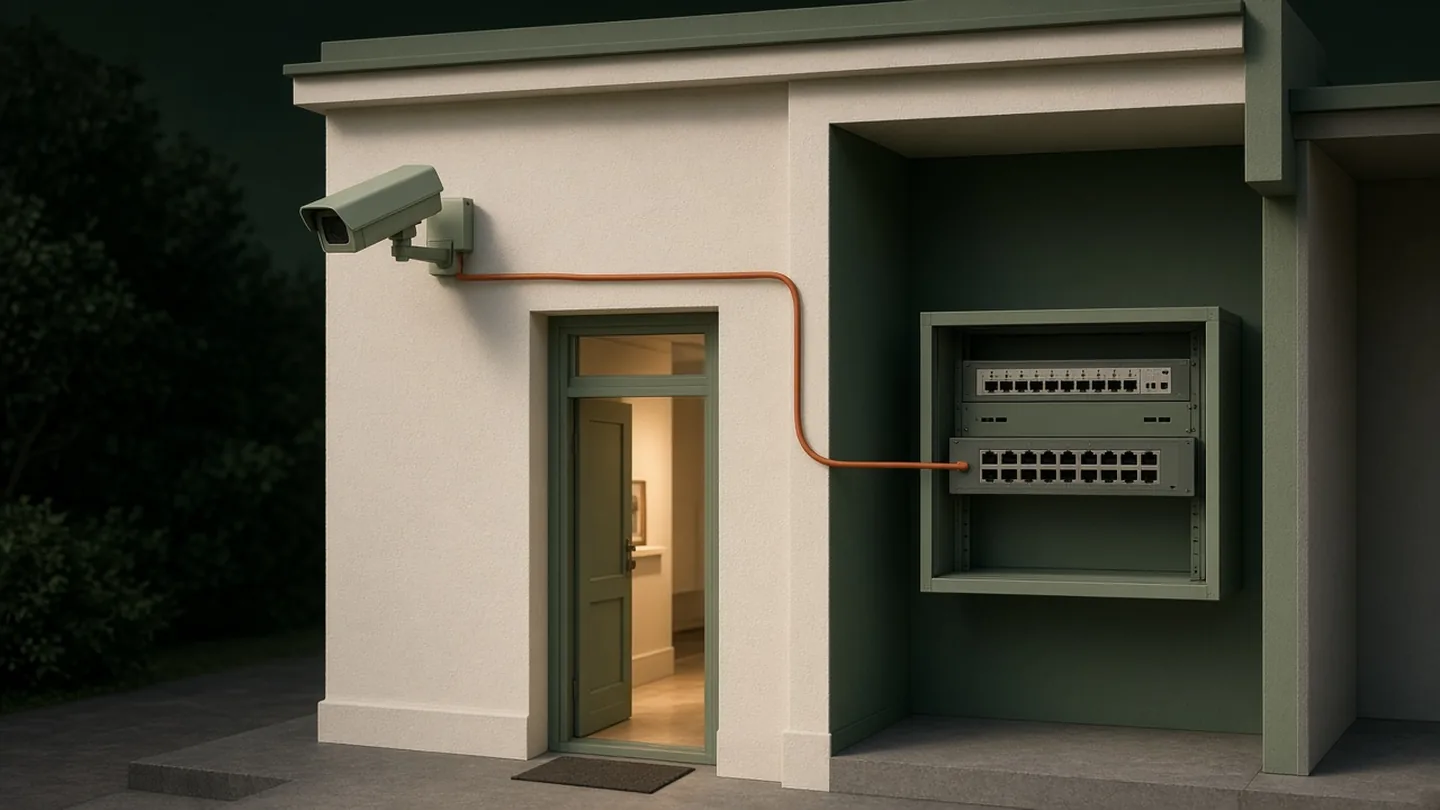
1. Start with the device list, including operating modes
Write down the exact camera, phone and access-point models before choosing a switch. Record the PoE standard and the power requirement for the intended operating mode. A camera with infrared lighting, a heater or a moving head may demand more than its quiet daytime reading. An access point may restrict features when supplied below its required power.
Read the device and switch documentation together. “PoE” on both boxes is not enough to establish compatibility. Standards-based 802.3af, 802.3at and 802.3bt equipment has different capabilities; a passive injector is a different arrangement and must match the device’s documented electrical requirements.
Also record devices you expect to add. A spare physical port is useful only if it has the right data capability, supported PoE output and remaining total power. This is especially relevant when adding several cameras to an existing small switch.

2. Check per-port capability and the total budget separately
| Check | Question | Evidence |
|---|---|---|
| Device compatibility | Does this device support the port’s PoE standard and mode? | Exact device and switch specifications. |
| Per-port allocation | Can this particular port supply the required allocation? | Port specification and controller settings. |
| Shared budget | Can all required ports be powered together? | Available total PoE budget and allocation policy. |
The switch’s total AC input rating is not the same number as power available to PoE devices. Some models also have different budgets with different power supplies or configurations. Use the PoE budget for the exact model, power supply and operating conditions, including any manufacturer temperature restrictions.
Keep the side of the measurement consistent. Device input power is measured after cable losses; a switch-side allocation may need to allow for those losses. Do not add device-side and switch-side figures as though they were identical. Where the vendor gives an approved sizing method, use it.
3. Work through a conservative allocation example
Hypothetical example, not a WireTrace field measurement: suppose a particular switch reserves 15.4 W for each of four cameras and 30 W for each of two access points. These are assumed switch-side allocations for this example, not a claim that every camera or AP consumes those amounts.
| Group | Quantity | Assumed allocation each | Group total |
|---|---|---|---|
| Cameras | 4 | 15.4 W | 61.6 W |
| Access points | 2 | 30 W | 60 W |
| Total allocated | 6 devices | — | 121.6 W |
| Example planning target | 25% above allocation | 121.6 × 1.25 | 152 W |
A 120 W available budget does not fit the assumed 121.6 W allocation. A 150 W budget fits the allocation but falls just below this example’s chosen 152 W planning target. The 25% addition is a planning assumption for this scenario, not an IEEE requirement or a universal allowance for every installation.
Your switch may reserve by class, use configured limits, negotiate through supported mechanisms or allocate in another documented way. Check the actual policy. If it reserves more than the device currently draws, adding idle measurements can underestimate the budget needed to bring every device online.
4. Check start-up and the demanding operating condition
When the installation is approved and connected, review the switch’s port status, allocations and event log. Look for denied power, overload or priority events. Record what happens as the full intended set of devices starts, and when features such as night lighting are active. Preserve service for security-critical cameras while arranging tests.
A camera reboot does not prove the total budget is too small. A cable termination, voltage drop, port limit, device fault or software problem can produce a similar symptom. Compare with a known-good short cable and compatible source when appropriate, and use a PoE instrument rated for the active connection if measurements are needed.
An ordinary voltage or PoE identification result does not demonstrate that the path sustains the required load. The existing identification-versus-load-testing guide explains that distinction. Keep the switch log and the observed device symptom alongside any measurement.
5. Choose an upgrade only after identifying the constraint
If total allocation is the limit, consider an adequately budgeted switch or a documented compatible power arrangement. If only one port lacks the required standard, a larger total budget alone will not make that port suitable. An injector can be appropriate for a single device when its standard, output, data path and installation are compatible.
Save the finished inventory with port numbers, expected maximums, allocation method and remaining margin. When another device is proposed, update the sheet before plugging it in. After changes, confirm all required cameras and AP features remain available together; a successful power-on of the newest device is only part of that check.
Keep the result, not just the impression
Common questions
Can I use the current watts shown by the switch to size everything?
Use them as observations, but also check peak requirements, start-up and the switch’s reservation policy. Idle draw alone may not represent the allocation needed for simultaneous operation.
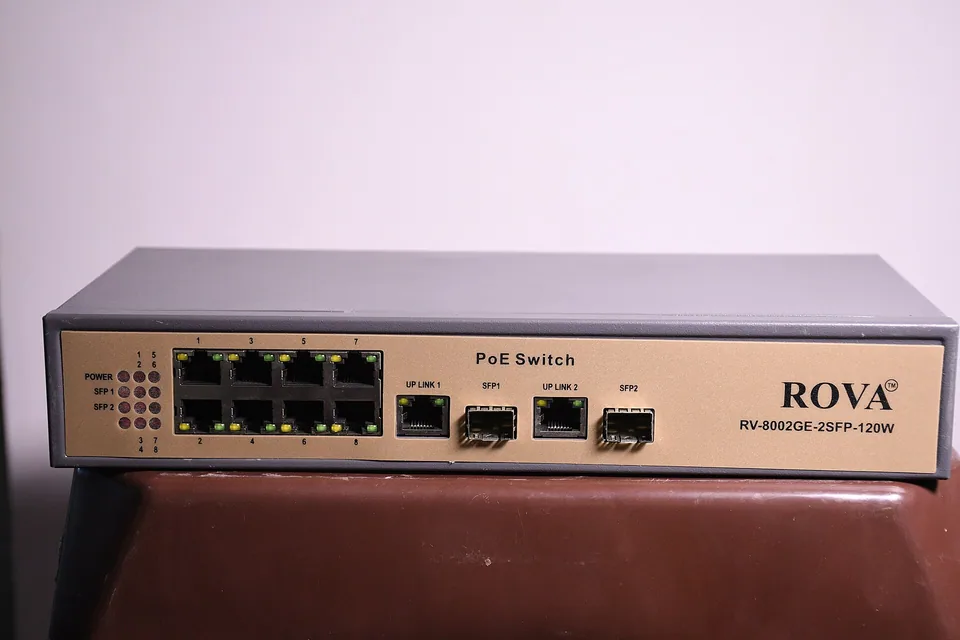
Does an eight-port PoE+ switch provide eight times 30 W?
Not necessarily. The advertised per-port capability and the shared total budget are different limits. Read the exact model’s available PoE budget and allocation rules.
Sources and scope
Example values are explicitly assumed switch-side reservations. Confirm device requirements and the exact switch’s allocation method before applying the arithmetic.
Related checks
- PoE camera keeps rebooting
- PoE identification versus load testing
- Choose equipment by the evidence required
Questions before you change anything
How do I size a PoE switch for cameras and access points?
List each endpoint’s maximum required power, PoE standard, per-port requirement and simultaneous demand. Account for the source’s stated budget method and cable loss; average idle consumption is not the planning ceiling.
Why does a switch with eight PoE ports fail to power eight devices?
Port count and total power budget are different. Check allocated power, port priority and PSU rating. A switch may support the needed standard on each port without supplying every port at its maximum simultaneously.
Why do cameras fail after dark or after a restart?
Compare IR illumination, heater load, cold-start demand and simultaneous boot. Record port events at the failure time instead of estimating from the daytime steady reading.
Can I mix passive and standards-based PoE devices?
Only with explicitly compatible voltage, polarity, negotiation method and pin usage. Connector shape is not a compatibility test; an unsuitable passive source can damage an endpoint.
Do I need a larger switch or a cable investigation?
Compare short-cable operation, far-end voltage, budget headroom and power-denial logs. A source upgrade solves insufficient available capacity; it cannot repair a high-resistance termination.
Questions and source links reviewed 21 November 2026. The answers apply the limits described in this guide; they are not a test of your equipment.

Reader questions that informed this update: Reddit: reader discussion. Individual reports help identify questions; answers above use the technical references in this guide.
Details worth checking
Does a PoE++ label guarantee every high-power device will run?
Check the exact IEEE type, class, supported pair use and manufacturer requirements at both the switch and powered device. “PoE++” is used broadly in listings. The switch must support the required mode on that port and have enough total allocation; a connector label or idle wattage is insufficient evidence.
Explain your own result
Replace the brackets with observations you actually made. Leave unknowns as “not checked”. This draft is written for this guide; it is not a quotation or an automatic diagnosis.
Copying stays on your device. Remove passwords, account numbers and private network details before sharing.
Reader questions that informed this update: Reddit: reader discussion. Individual reports help identify questions; answers above use the technical references in this guide.